
Living Museum of Learning
He Animated Group Theory in Motion
Peter began learning programming and mathematics in Grade 4 under Donald.
Over seven years, his learning was shaped not only by instruction but by sustained curiosity, competitions, and deep problem-solving.
By Grade 9, he had already earned multiple math competition medals and led teams to provincial and robotics championships.
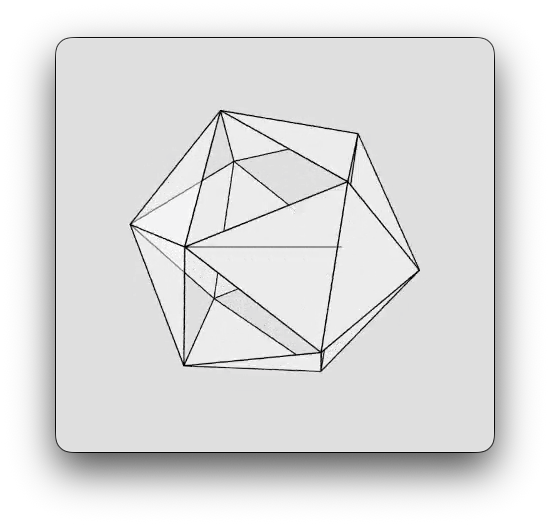
In an 18-second animation, Peter used code to demonstrate group theory.
He rotated an icosahedron (a 20-faced polyhedron) along an axis connecting two opposite vertices.
What would normally remain an abstract algebraic concept—symmetry group actions—became visible as motion in space.
The moment the rotation ran, algebra stopped being symbolic and became perceptual.
Group theory, often considered highly abstract, became something Peter could see.
The icosahedron no longer represented a formula—it became a dynamic object obeying structure.
This is the point where abstraction “locks into place”:
symmetry becomes motion
algebra becomes geometry
reasoning becomes intuition
The idea is no longer learned—it is inhabited.
Deep mathematical understanding often emerges from long-term exposure, dialogue, and repeated re-encounter with ideas across contexts.
Competitions, discussions, and programming all served as different “views” of the same underlying structures.
When abstraction is revisited enough times, it stops feeling abstract.
It becomes part of everyday mental operations—the “daily use” of mathematics.
Even advanced mathematical structures like group theory can be internalized deeply enough to be expressed visually and intuitively through programming.
Through years of layered learning—combining coding, competitions, discussion, and repeated exposure to the same core ideas in different forms.
Abstract mathematics is often seen as inaccessible, but with enough embodied interaction, it becomes part of a student’s natural cognitive toolkit.
This transforms “advanced math” from a barrier into a medium of expression.