
Living Museum of Learning
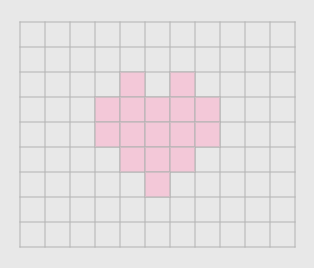
A Pink Heart in the Game of Life
We had just finished writing the p5.js rendering code for Conway's Game of Life. The program could now display a two-dimensional world of 0s and 1s, and we were ready to place some of the classic patterns into the grid.
I suggested examples such as a beehive, a pond, or other well-known stable structures.
Nicole chose none of the traditional patterns.
Instead, she carefully placed individual cells into the array, drawing a heart one square at a time. She displayed it in pink.
At that moment, the two-dimensional array stopped being merely a data structure.
It became a space for expression.
Most beginners approach the Game of Life by asking:
"What will this pattern become?"
They focus on oscillators, stable structures, and moving patterns.
Nicole asked a different question:
"What do I want this world to look like?"
Before exploring evolution, she first created meaning.
A simple world of 0s and 1s became a heart.
The Game of Life is usually introduced as a system of rules and evolution.
Nicole approached it as a medium for expression.
She showed that computational thinking does not always begin with rules, algorithms, or optimization. Sometimes it begins with the desire to create something meaningful.
The array became more than data.
It became a canvas.