
Living Museum of Learning
A Beautiful Trick to Avoid Trigonometry
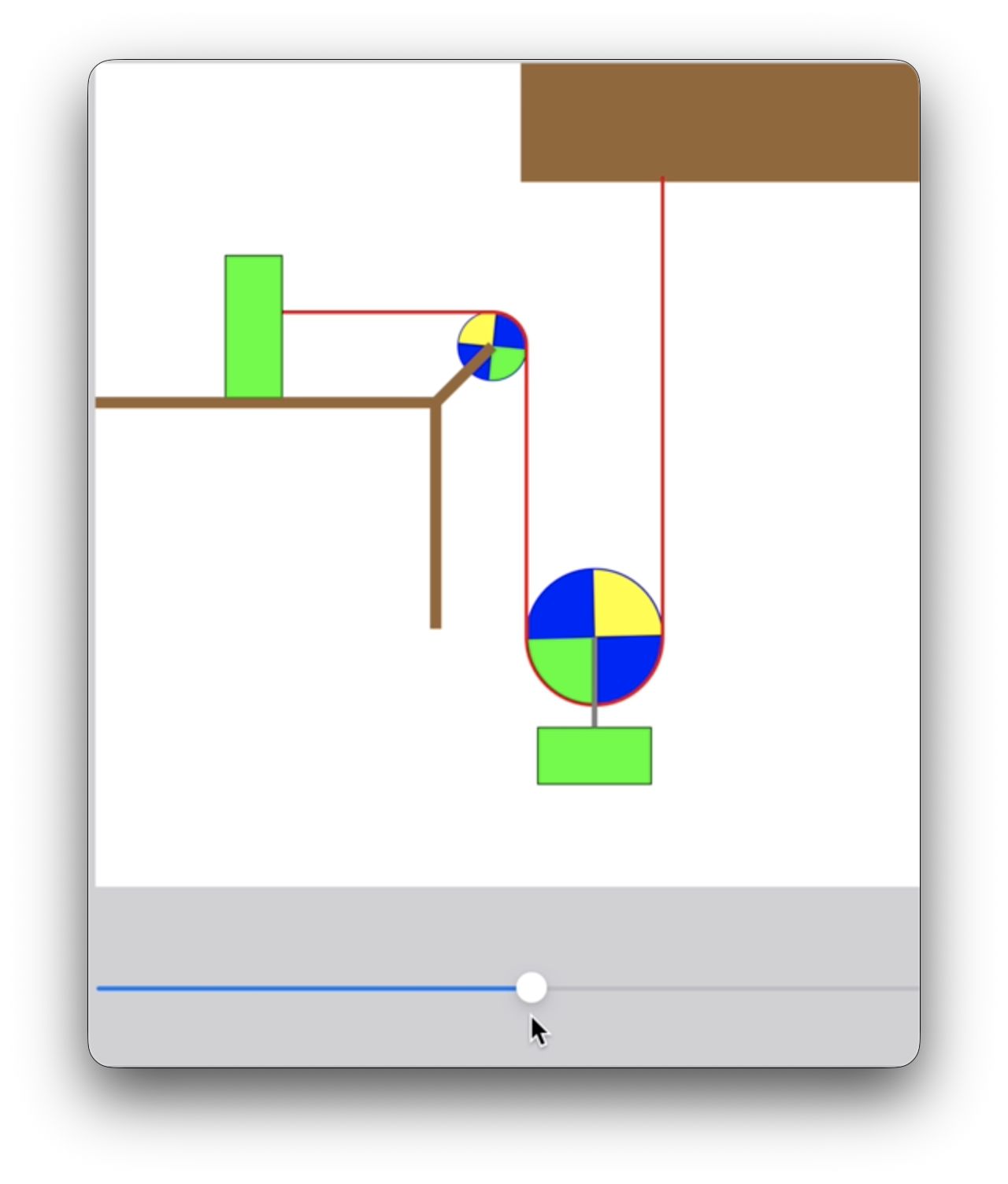
Three years ago, Kenneth and I built a small iOS simulation: two wheels connected by a rope and controlled by a moving slider.
The visual goal was straightforward. As the slider moved, both wheels should rotate naturally and remain perfectly synchronized.
The mathematical challenge seemed equally obvious:
Rotation means sine and cosine.
Or does it?
Instead of asking how to compute circular motion with trigonometry, we asked a different question.
Can the wheels rotate using only the movement of the rope?
The key insight came from a simple geometric identity:
arc length = radius × angle
Rearranging the equation gives:
angle = arc length / radius
The slider controls only one quantity: the amount of rope displaced.
Once the rope length is known, the rotation angle follows automatically.
No sine.
No cosine.
No trigonometric functions at all.
What initially appeared to be a trigonometry problem became a problem about length.
As the rope moved, the system performed three simple steps:
measure the rope displacement
divide by the wheel radius
rotate the wheel by the resulting angle
The two wheels spun smoothly and remained synchronized.
A 19-second recording captured the result: a tiny physical system emerging from a single geometric constraint.
The mathematics did not disappear.
It became simpler.
Difficult problems sometimes disappear when the question changes.
Geometry can replace computation.
Constraints often simplify a system.
Elegant solutions remove unnecessary machinery.
Understanding relationships is often more powerful than applying formulas.